

Home > Is Help Really Helping? Colonial legacies of power dynamics in the Museum
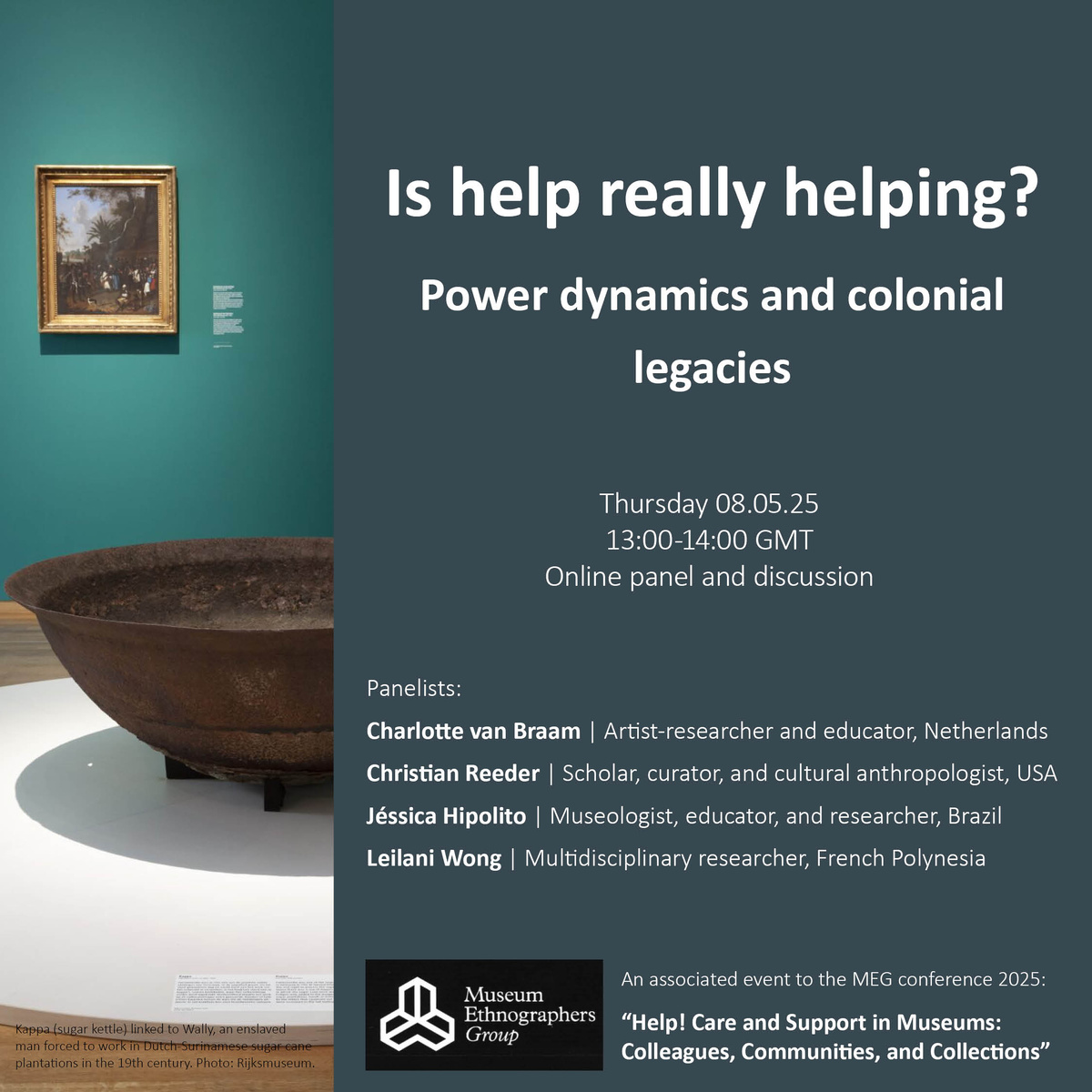
Is Help Really Helping? Colonial legacies of power dynamics in the Museum

Museums often position their outreach to marginalized communities as benevolent gestures of inclusion. But when institutions rooted in colonial legacies ask for “help” from those they historically subordinated, how does this request embody colonial power dynamics, and what histories are activated beneath these gestures?
This panel interrogates the ethics and ontology of "help" within museum spaces—examining when it becomes a continuation of extractivism, and when it can be transformed into meaningful solidarity.
Drawing on their personal histories and professional work across the Global North and South, four fellows of the Sharing Stories on Contested Histories program explore themes of ancestral memory, colonial infrastructure, racial capitalism, and the emotional toll of institutional engagement. Centering the Surinamese kappa (sugar cauldron) at the Rijksmuseum—a relic of slavery and resistance—the conversation asks: Can museums truly care for people, or only for objects? Can justice be achieved through the very structures built to uphold dominance?
Together, the panelists reflect on knowledge, conservation, and resistance as living practices. They offer not a roadmap for reform, but a provocation: what if true help begins with refusal, unlearning, and a redistribution of power?
Panelists:
Charlotte van Braam | Artist-researcher and educator, Netherlands
Christian Reeder | Scholar, curator, and cultural anthropologist, USA
Jéssica Hipolito | Museologist, educator, and researcher, Brazil
Leilani Wong | Multidisciplinary researcher, French Polynesia